
Bio-inspired Autonomous Flight for the Future of Power Infrastructure
FreeFly is a research project led by Professor Emad Samuel Malki Ebeid at the University of Southern Denmark (SDU).
The project explores a new generation of bio-inspired autonomous flying robots capable of operating persistently around high-voltage power infrastructure.
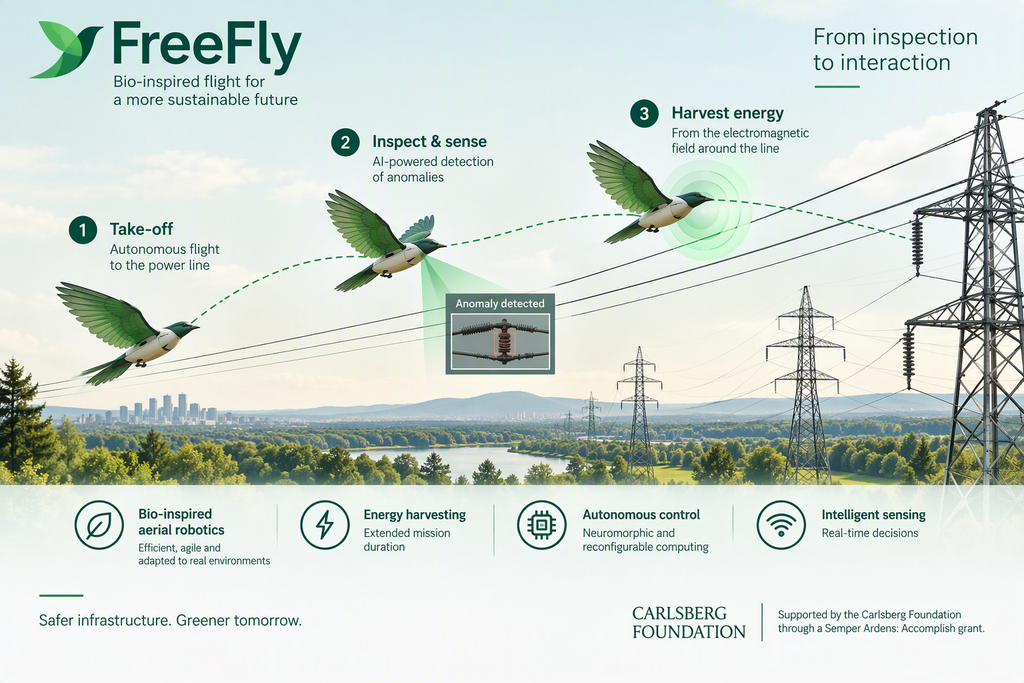
FreeFly combines bio-inspired aerial robotics, energy harvesting, intelligent sensing, autonomous control, and advanced onboard computing to investigate how future flying robots can inspect and interact with critical infrastructure.
The FreeFly Vision
FreeFly asks a fundamental question:
What if a flying robot could obtain the energy it needs while operating around power lines?
The project investigates small, bird-inspired flapping-wing robots, or ornithopters, capable of operating close to high-voltage infrastructure.
The vision is to enable persistent autonomous flight by combining efficient bio-inspired flight with energy harvesting from the electromagnetic environment surrounding power lines.
Rather than frequently returning to a charging station, future FreeFly robots could remain around the electricity grid for extended periods, continuously sensing their surroundings and making intelligent decisions.
Research
Bio-inspired Aerial Robotics
FreeFly investigates bird-inspired flying robots designed for agile and efficient operation around power infrastructure.
Energy Harvesting
The project explores harvesting energy from the electromagnetic environment surrounding power lines to support flight, sensing, and onboard computing.
Intelligent Sensing
FreeFly investigates sensing technologies that allow aerial robots to monitor infrastructure and identify potential problems during autonomous operation.
Autonomous Control
The flying robots must navigate independently, adapt to changing conditions, and make real-time decisions while operating close to power infrastructure.
Advanced Onboard Computing
FreeFly investigates energy-aware computing approaches, including neuromorphic and reconfigurable computing, to enable intelligent real-time decisions directly onboard the flying robot.

From Inspection to Persistent Autonomy
The ambition of FreeFly goes beyond conventional drone inspection.
The project investigates how bio-inspired flying robots can become persistent autonomous systems operating around the electricity grid.
The research progresses from:
Fly
↓
Inspect and sense
↓
Harvest energy
↓
Operate persistently
The long-term goal is intelligent aerial robots capable of supporting safer, more efficient, and more sustainable management of critical energy infrastructure.
About Professor Emad Samuel Malki Ebeid
Professor Emad Samuel Malki Ebeid is Professor and Head of the Digital and High-Frequency Electronics Section at the University of Southern Denmark.
His research focuses on autonomous aerial robotics, energy-aware embedded systems, intelligent sensing, advanced onboard computing, and autonomous technologies for power infrastructure.
Professor Ebeid leads FreeFly with the ambition of developing a new class of intelligent aerial robots capable of operating autonomously and persistently around critical infrastructure.
Project Facts
Project: FreeFly
Principal Investigator: Professor Emad Samuel Malki Ebeid
Host Institution: University of Southern Denmark (SDU)
Funding: Carlsberg Foundation – Semper Ardens: Accomplish
Grant: DKK 12,998,750
Project Budget: Approximately DKK 13 million
Project Period: 1 July 2026 – 30 June 2031
Research Areas: Bio-inspired aerial robotics, energy harvesting, autonomous control, intelligent sensing, and advanced onboard computing
Supported by the Carlsberg Foundation
FreeFly is supported by the Carlsberg Foundation through a Semper Ardens: Accomplish grant.
The project brings together ambitious fundamental research in bio-inspired robotics, autonomous systems, energy harvesting, sensing, and computing to explore a new generation of flying robots for future power infrastructure.